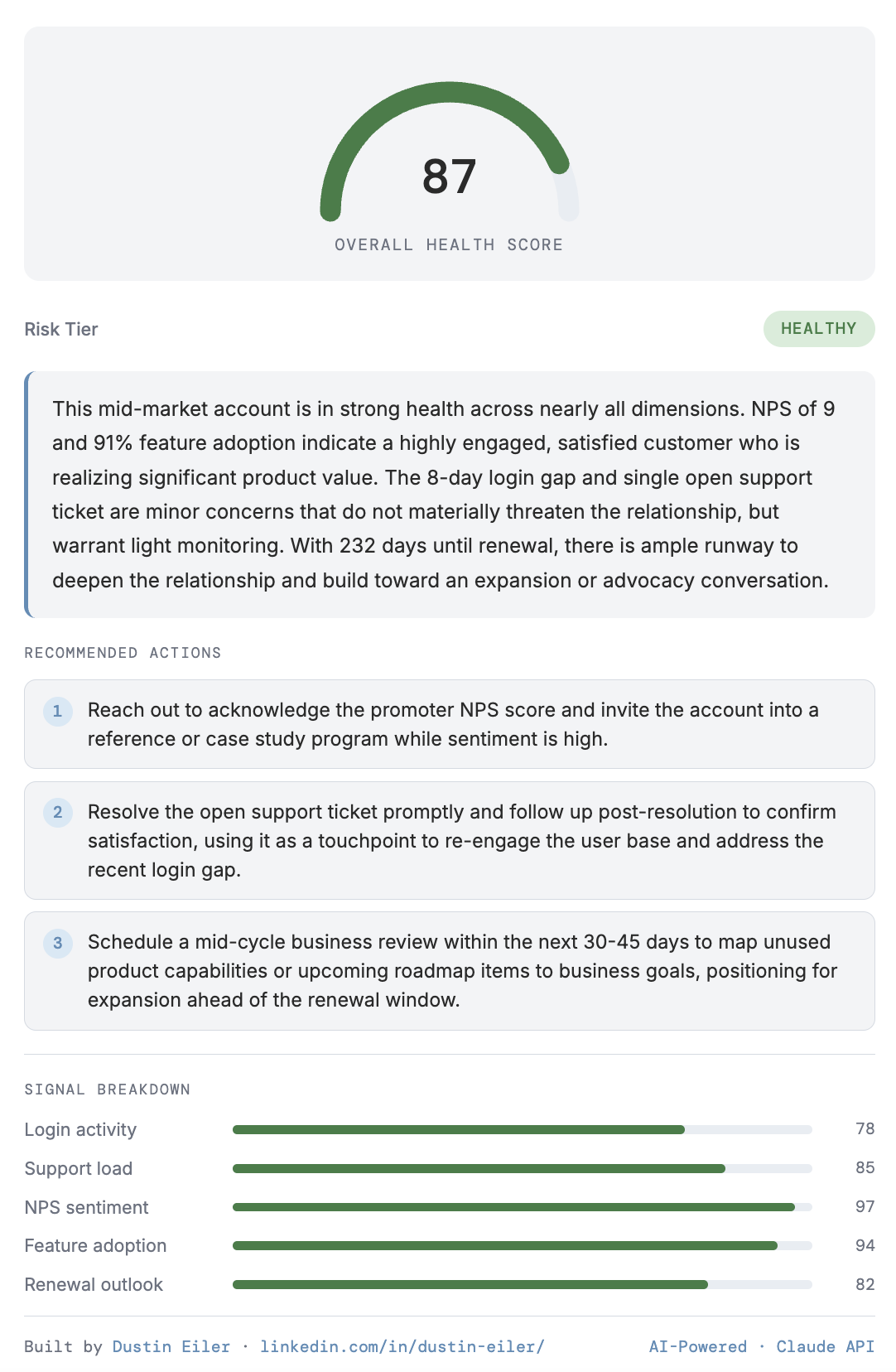
Most CS teams find out an account is at risk when it's already too late. I built this tool to demonstrate how I think about getting ahead of that problem, turning the signals that actually matter into a real-time health assessment, risk tier, and recommended actions before a relationship deteriorates. The methodology behind it is the same one I used to drive CSAT from below 80% to a sustained 93% at Net32.
Build the Scorecard Before the Fire Starts
The problem: Customer health is one of the most important things a CS organization can track, yet it is one of the most poorly operationalized aspects. Most teams rely on gut feel, lagging indicators like churn or a support spike, or a spreadsheet that someone updates once a quarter. By the time the warning signs are visible, the window for intervention has already narrowed. The gap between knowing an account is struggling and acting on it early enough to matter is where retention is won or lost.
What I built: An AI-powered customer health scoring engine that takes seven key account signals, days since last login, open support tickets, NPS score, feature adoption rate, days until renewal, engagement trend, and account segment, and runs them through Claude's API to generate a weighted health score, a risk tier, a plain-English analyst summary, and three specific recommended actions. Built the front end from scratch, deployed a secure Cloudflare Worker proxy to keep the API key server-side, and hosted the tool on GitHub Pages as a fully live, interactive application. The entire stack, from methodology to deployment, was designed and built independently.
The outcome: A working, publicly accessible tool that demonstrates how I think about early warning systems in customer success, not as a concept but as a built thing. The health scoring logic reflects the same frameworks I used at Net32 to build lifecycle management infrastructure from zero, and at Well Life to deploy AI-powered tooling that reduced operational errors by over 80%. The tool is live, linkable, and sits on this site as proof that AI fluency isn't a buzzword on my resume. It's how I actually work.